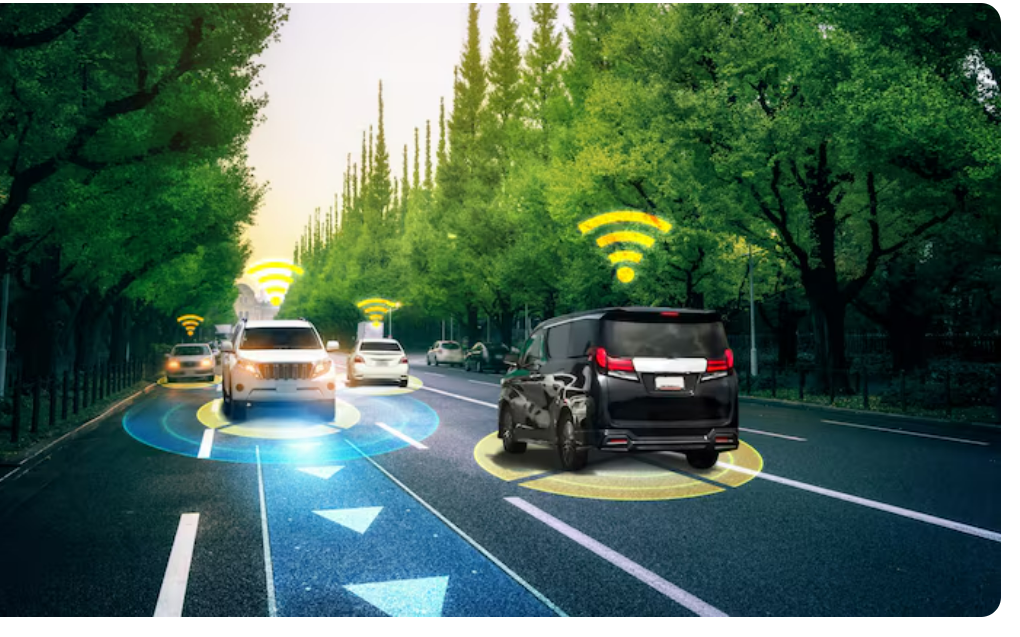
The Internet of Vehicles, or IoV, is a disruptive technology that comes with very minor latency time and high bandwidth support for the inter-connection of the entire traffic: vehicles, roads, and users. But this huge interconnection also makes vehicular networks vulnerable to various attacks like denial-of-service, impersonation, botnets, and zero-day attacks. The paper provides an overview of the latest trends in intrusion detection systems enabled by artificial intelligence (AI), such as machine learning (ML), Deep learning (DL), and hybrid methods in IoV networks. Aspects like ensemble-based training, deep neural design, knowledge distillation, and privacy-preserving systems such as federated learning and homomorphic encryption are being discussed. The performance evaluation conducted on both the actual and standard datasets shows that these complex ML/DL architectures are not only highly accurate but also very fast with short delays and are capable of detecting both regular and new threats. Other challenges like unbalanced data, low-power devices, zero-day attacks, and model interpretability are also examined. Moreover, the recent progress made in AI-based IDS and privacy-aware systems points towards a trend of a scalable, secure, and trusted IoV. The paper provides an overview of current trends, emphasizes necessary future research, and gives a glimpse of resilient IDS that would be able to secure vehicular networks in advanced and automated transportation systems.
Keywords : IoV, Intrusion Detection System, FL, Anomaly Detection, Autonomous Vehicles, Security.
Authors : S Sunil Kumar , G Lokesh , Sandeep Konchada
Title : Securing Internet of Vehicles (IoV) : Robust Machine Learning Models
Volume/Issue : 2025;2(4 (October-December))
Page No : 60 - 67

 ISSUE: Volume 2 (2025) , Issue 4 (October-December)










 Cover Page





 Manuscript Status