

 Privacy Policy
International Journal of Computational Science and Engineering Research, e-ISSN: 3107 - 8605 is a Inter disciplinary double-blind Peer-Reviewed Research Open Access Journal maintaining academic honesty and integrity is of utmost importance. We are committed to publishing original research and expect all submitted manuscripts to be the authors' own intellectual contributions. Plagiarism, in any form, is strictly prohibited and considered a serious breach of publication ethics.
Plagiarism includes, but is not limited to Copying text, ideas, images, or data from another source without proper citation. Reproducing large portions of one’s own previously published work (self-plagiarism) without appropriate referencing. Submitting work that closely resembles another author’s work, even if paraphrased, without acknowledgment.Using AI-generated content or translation tools without transparency or appropriate review and verification.
All sources must be properly cited, and quotations must be clearly marked. Even when information is paraphrased, the original author must be credited.
Generative AI Policy
International Journal of Computational Science and Engineering Research,e-ISSN: 3107 - 8605 published by Jack Sparrow Publishers, we are committed to maintaining the highest standards of integrity, originality, and transparency in scholarly publishing. As part of our adherence to Scopus indexing evaluation standards and global ethical publishing practices, we have implemented clear Generative Artificial Intelligence (AI) Policies for authors, reviewers, and editors.
Use of Generative AI Tools
International Journal of Computational Science and Engineering Research recognizes that Generative AI technologies (such as ChatGPT, Copilot, Gemini, and similar tools) can assist in research development, data analysis, and manuscript preparation. However, their use must be responsible, transparent, and compliant* with ethical publishing norms.
Authors must disclose the use of any Generative AI tools in the Acknowledgment or Methods section of their manuscript, specifying the purpose and extent of use (e.g., language editing, idea generation, or coding assistance).
Generative AI tools cannot be listed as co-authors, as they do not meet authorship criteria defined by the COPE (Committee on Publication Ethics) and Scopus, Web of Science Indexing standards. The intellectual responsibility for the content, interpretation, accuracy, and originality of the manuscript remains entirely with the human authors.
Prohibited Use
Submitting AI-generated content without disclosure or misrepresenting AI-generated text, images, or data as original human work constitutes academic misconduct and may result in manuscript rejection or retraction. AI tools should not be used to fabricate data, citations, or experimental results.
Editorial and Review Process
International Journal of Computational Science and Engineering Research employs plagiarism detection and AI-content screening tools to ensure all submissions comply with our ethical and publication integrity standards. Editors and reviewers are trained to identify and evaluate the appropriate use of AI-generated content within submitted manuscripts.
Commitment to Transparency and Ethics
Through these policies, International Journal of Computational Science and Engineering Researchaims to promote responsible innovation and uphold research quality aligned with Scopus indexing criteria, COPE guidelines, , Clarivate Academia & Research Genarative AI Policy , and global best practices in scholarly publishing. We encourage authors to use AI tools as a means of enhancement not replacement of human creativity and critical thinking.
Unacceptable Use of Generative AI
The following uses of Generative AI are " Strictly Prohibited " :
Data fabrication or falsification : Creating synthetic results, experiments, or references. Undisclosed AI-generated writing or images presented as original work. AI-generated citations or references that are unverifiable. AI-assisted peer review reports submitted without human oversight. Listing AI tools or systems as co-authors, as they lack accountability, consent, and the ability to take intellectual responsibility. Violation of these guidelines constitutes academic and Research misconduct and may result in: Immediate Rejection of the manuscript, Retraction of published articles, and Notification to authors’ affiliated institutions.
Editorial and Peer Review Procedures
International Journal of Computational Science and Engineering Research editorial board and Strict Double-Blinded review policy employs a combination of human oversight and digital tools to ensure ethical compliance, including:
Plagiarism detection systems (e.g., Turnitin, iThenticate). AI-content screening tools to identify machine-generated text or images.Verification of author disclosure statements related to AI use. Reviewer training to detect inconsistencies or overreliance on AI in submitted manuscripts. Editors and reviewers may request additional clarifications or source verification, if AI involvement is suspected or unclear.
Responsibilities of Authors, Reviewers, and Editors. Authors must disclose AI use and remain accountable for all content integrity. Reviewers should avoid using AI tools to generate review reports without authorization and must maintain the confidentiality of the manuscript. Editors must ensure fair assessment, adherence to COPE and Scopus ethical standards, and prevent bias in editorial decisions involving AI-assisted manuscripts.
Compliance and Ethical Oversight
International Journal of Computational Science and Engineering Research Generative AI policy is guided by:
COPE (Committee on Publication Ethics) guidelines on AI use in research., Scopus’s Ethical Publishing and Content Policy Framework. and Elsevier’s AI Authorship Guidelines (2023) , Clarivate Academia & Research Genarative AI Policy and International Academic Integrity Standards.
Publication Ethics
The authors affirm that this research paper adheres to the ethical standards and publication policies established by International Journal of Computational Science and Engineering Research. All work presented in this paper is original and has not been published, submitted, or under consideration in any other journal or conference. Proper credit has been given to all sources of information, data, and previous studies through appropriate citations and references. The manuscript has been prepared with honesty, transparency, and integrity, ensuring that all findings are reported accurately without fabrication, falsification, or manipulation of data.
All authors have significantly contributed to the conception, design, analysis, and interpretation of the study and have reviewed and approved the final version of the manuscript before submission. The research complies with international ethical guidelines for academic and scientific publishing, including respect for intellectual property rights and avoidance of plagiarism or duplicate publication. The authors also commit to cooperating with the editorial team in addressing any ethical concerns that may arise during or after publication. This declaration ensures accountability, fairness, and adherence to the professional standards expected by International Journal of Computational Science and Engineering Research and the broader research community.
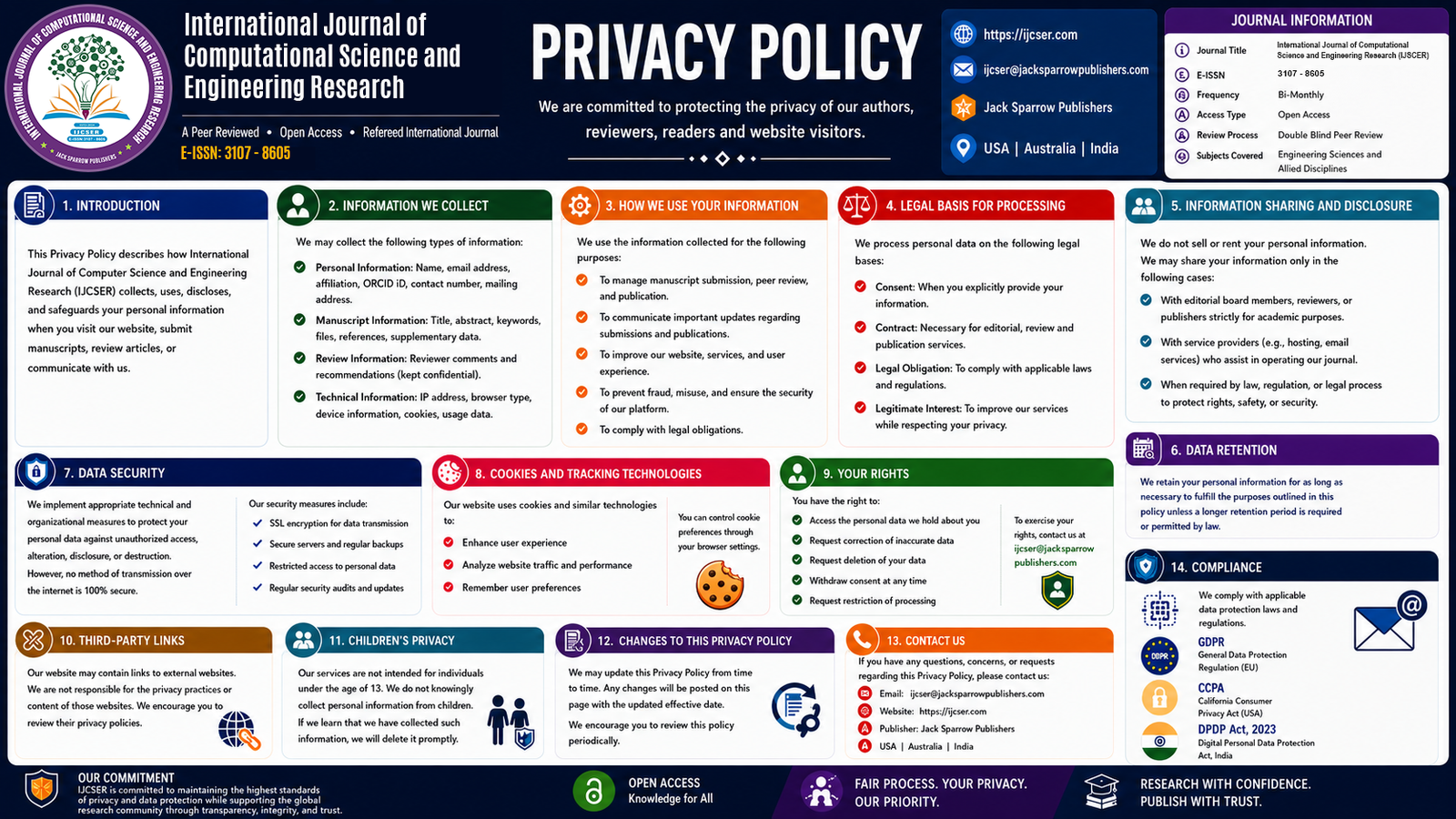
Privacy Policy
Privacy Policy for International Journal of Computational Science and Engineering Research
International Journal of Computational Science and Engineering Research is committed to protecting the privacy and confidentiality of the personal information of its users, including authors, reviewers, editors, and other stakeholders who interact with our website and services.This Privacy Policy outlines how we collect, use, and protect your personal information. By using our website or submitting to the journal, you agree to the terms of this Privacy Policy.
Information We Collect : We collect different types of information to ensure the proper functioning of the IJCSER website and services. The types of information collected may include:
Personal Identification Information: When you submit a manuscript, register as an author or reviewer, or subscribe to our newsletter, we may collect personal details such as:
- Name
- Email address
- Affiliation (e.g., institution or organization)
- Address
- Phone number (if applicable)
- ORCID ID (optional but recommended)
Submission Data: When you submit a manuscript or review, we collect relevant submission data, including the manuscript content, metadata, and any associated files (such as figures, tables, and supplementary material).
Usage Data: We may collect information about how you interact with the IJCSER website, such as:
- IP address
- Browser type and version
- Time zone settings
- Pages visited
- Date and time of access
- Referring website addresses
Cookies: Our website may use cookies or similar technologies to enhance user experience, personalize content, and analyze usage patterns. You can control the use of cookies through your browser settings.
How We Use Your Information : The information we collect is used for the following purposes
To Communicate with You: To send notifications about your submissions, editorial decisions, and updates regarding our journal.
To Improve Our Website : To understand how users interact with the website and enhance the functionality and user experience.
To Send Promotional Materials : If you have opted in, we may send you information about upcoming issues, events, or opportunities related to IJCSEAI. You can opt-out of these communications at any time.
For Legal Compliance : We may use or disclose your information to comply with applicable laws, regulations, or legal processes, including responding to government or law enforcement requests.
How We Protect Your Information : We are committed to ensuring that your personal information is secure. We implement appropriate technical and organizational measures to safeguard your data, including
Encryption : Sensitive information, such as login credentials and submission data, is encrypted during transmission using industry-standard encryption protocols (e.g., SSL/TLS).
Access Control : Access to your personal information is restricted to authorized personnel only, including members of the editorial team and those involved in the peer review process.
Regular Audits: We perform regular security audits to identify and mitigate potential risks to data security.
Data Retention : We retain your personal information and submission data for as long as necessary to fulfill the purposes outlined in this Privacy Policy, including for the duration of your manuscript’s review, publication, and archival. After that period, we may retain anonymized or aggregated data for research or statistical purposes, but any personally identifiable information will be deleted or anonymized.
Sharing Your Information: We respect your privacy and will not sell or rent your personal information to third parties. However, we may share your information in the following circumstances:
With Reviewers: To facilitate the peer review process, we may share your manuscript and associated data with selected reviewers, editors, or other experts in the field.
With Service Providers: We may share your information with trusted third-party service providers who assist with website hosting, email communication, data analysis, and other administrative functions. These service providers are required to use your information only as necessary to perform their services and are bound by confidentiality obligations.
Legal Obligations: We may disclose your information if required to do so by law or in response to valid legal requests by public authorities (e.g., subpoenas, court orders).
Your Rights and Choices: As a user, you have certain rights regarding your personal information. These rights may vary depending on your location and applicable data protection laws. They include:
Access: You have the right to request access to the personal data we hold about you and to receive a copy of that data.
Correction: You can request that we correct any inaccurate or incomplete personal data we hold about you.
Deletion: You may request that we delete your personal data, subject to any legal obligations to retain it.
Withdrawal of Consent: If we process your data based on your consent, you may withdraw that consent at any time. For example, if you no longer wish to receive our newsletters, you can unsubscribe via the provided link.
Objection to Processing: You may object to the processing of your personal data in certain circumstances, such as if you believe it is being processed unlawfully.
To exercise any of these rights, please contact us at the details provided below. We will respond to your request in accordance with applicable data protection laws.
Third-Party Websites : Our website may contain links to third-party websites for the convenience of our users. These third-party sites are not under our control, and we are not responsible for their privacy practices. We encourage you to review the privacy policies of any third-party websites you visit.
Children's Privacy : IJCSEAI does not knowingly collect personal information from children under the age of 16. If you are a parent or guardian and believe that your child has provided personal information to us, please contact us so that we can take appropriate action to remove the data.
Changes to This Privacy Policy: We reserve the right to update or modify this Privacy Policy at any time. Any changes will be reflected on this page with an updated effective date. We encourage you to review this Privacy Policy periodically to stay informed about how we protect your information.
Plagarism Policy
International Journal of Computational Science and Engineering Research strictly enforces a zero-tolerance plagiarism policy to maintain the integrity and credibility of published research. All submitted manuscripts must be original, unpublished, and free from any form of plagiarism, including direct copying, paraphrasing without citation, or duplication of previously published work. Authors are required to properly acknowledge all sources of information, data, images, and ideas referenced in their study.Plagarism must be below 10% Plagarism without AI and Humainzed, Bypass Plagarism including 7 types.
Manuscripts undergo a rigorous plagiarism check using reliable detection software before the peer review process. Any submission found to contain significant similarity with existing work may be rejected outright, and in cases of severe misconduct, the authors may face further sanctions, including a ban on future submissions. Minor similarities identified during review must be appropriately revised with proper citation.
The journal encourages authors to follow ethical writing practices, ensure originality, and disclose any overlapping content transparently. By enforcing this policy, IJCSEAI upholds high academic standards, promotes ethical research, and ensures that all published work contributes genuinely to the advancement of knowledge in engineering, science, and technology.
Conflict of Interest
The authors declare that there are no conflicts of interest regarding the publication of this research paper. This includes financial, personal, or professional relationships that could be perceived as influencing the results, interpretation, or presentation of the study. The research work has been conducted independently, without any external pressure, sponsorship, or organizational bias that could affect the objectivity of the findings. All authors have contributed fairly to the conception, analysis, and preparation of this manuscript and collectively accept responsibility for its content and conclusions.
No part of this research has been influenced by commercial or financial interests, and there are no competing affiliations that may compromise the integrity of the work. The authors affirm that all data and results have been presented truthfully and transparently, following the ethical and publication standards of the International Journal of Computer Science, Engineering and Artificial Intelligence. This declaration ensures that the research remains unbiased and maintains the highest level of academic and professional integrity. The authors further agree to disclose any potential conflicts should they arise in the future, ensuring continued transparency and trust in the research process.
Double Binded Peer Review Process
The double-blind peer review process is a standard method used to ensure impartial and unbiased evaluation of scholarly manuscripts. In this system, both the authors and the reviewers remain anonymous to each other throughout the review process. This anonymity minimizes potential biases related to the authors’ identity, affiliation, reputation, gender, or nationality, allowing the manuscript to be judged solely on its scientific merit, originality, methodology, and clarity.
Upon submission to the journal, the manuscript is first screened by the editorial team for compliance with formatting, scope, and ethical guidelines. If deemed suitable, it is forwarded to independent expert reviewers who evaluate the study based on predefined criteria such as research quality, novelty, data integrity, and relevance to the field. Reviewers provide constructive feedback, suggestions for improvement, and recommendations regarding acceptance, revision, or rejection.
The IJCSER Journal editorial board considers the reviewers’ reports while making the final decision, ensuring transparency, fairness, and accountability. Authors are required to address reviewer comments during revisions, maintaining the integrity of the publication process. By maintaining the double-blind system, IJCSER journal uphold rigorous academic standards, reduce potential conflicts of interest, and promote high-quality, objective, and credible scientific publications.
 News Board
 Cover Page




 Manuscript Status